


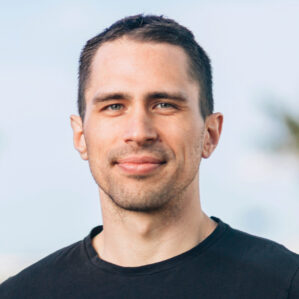
Noah Ready-Campbell the founder and CEO of Built Robotics, a company that transforms heavy equipment into autonomous robots that help build large-scale renewable energy projects, including solar farms across the U.S. Built’s robots have helped build critical infrastructure across the United States and Australia. Ready-Campell will serve as the Barer Keynote Speaker at the 2026 M&T Summit, where he will receive the Distinguished Alumni Award. In the below Q&A, Ready-Campbell talks about why he loves the career path he chose and the how the M&T Program helped prepare him for the work he does.
Q: Tell us about your current role and what you love most about the work you do.
NCR: I’m the founder and CEO of Built Robotics. We design and manufacture robots that autonomously construct different parts of solar farms, then deploy them into the field alongside some of the biggest construction companies in the country. Our goal is to help build the renewable infrastructure the world needs.
I love my job – it’s honestly hard for me to imagine something more fun. It’s a fascinating intellectual challenge to work at the cutting edge of robotics, AI, and real-world deployment and work with our engineering team to solve tough technical problems. I am incredibly lucky to work with a talented, dedicated, and mission-driven team to build renewable energy infrastructure. Solar has become the cheapest form of electricity generation, so it cuts across the political spectrum. Everyone wants cheaper, more reliable power, and we are working to bring it to communities across the country.
Q: What originally drew you to a career at the intersection of business and technology?
NCR: It really goes back to spending my high school and early college summers working with my dad, who was a carpenter. At the time, I didn’t love it – it was hard work and early mornings – but it shaped how I think about the world. I remember driving around with him and he’d point out houses he helped build. There was something powerful about seeing the literal mark he’d left on the world.
Though my first job out of school was at Google, and I later started an e-commerce business that I sold to eBay, I kept being drawn back to construction. It’s one of the few industries where you’re physically building the future and there’s enormous room for innovation. Construction is the only major sector of the economy where productivity hasn’t improved in the last 50 years – buildings often cost more today, adjusted for inflation, than they did in the 1970s. That’s a huge opportunity for technology to make a real difference.
Q: How did your time in the M&T Program prepare you for this work?
NCR: I found out about M&T through a Penn brochure when I was applying to college, and it stood out because I knew I wanted to be in tech but also wanted to understand business.
For me, it was the perfect education. I got a very rigorous engineering background, including a master’s in computer science, and the business and economics classes fundamentally changed how I think about the world. Understanding markets, incentives, and strategy has been just as important as understanding software and robotics.
Q: What major trend in the business-technology space excites you right now?
NCR: It’s hard to overstate the importance of what’s happening in the energy infrastructure. In 2024, more than 80% of new power infrastructure in the U.S. was solar and batteries. Five or ten years ago, that was not the case at all.
Solar is now cheaper than any other form of power and is much faster to deploy, which makes it incredibly attractive. We’ve completed 36 projects across Australia and the United States – including in Florida, California, Texas, Arizona, and Oklahoma. We have an upcoming project in Oregon and it’s exciting to see this transformation expand and grow.
Q: What advice would you give to students hoping to follow a similar path?
NCR: I have three pieces of advice for students. The first is to invest in your technical education. If you understand the engineering, you’ll have a much better grasp of the strategy behind tech companies. Technology is evolving incredibly fast right now, especially with AI, and being fluent in it will give you leverage.
Secondly, just start. A lot of people wait for the perfect idea or opportunity, but a side project is one of the best ways to learn what it takes to build something. It doesn’t have to be venture capital-ready – it just has to be real.
Finally, entrepreneurship is less risky than people think. People worry if their startup doesn’t work out, they’re going to be on the streets, and that’s not necessarily true. People take their fears of failing in a social context and project it into a financial context, and if you’re aware of that it’s easier to separate the two.
Q: What does it mean to you to receive the Distinguished Alumni Award?
NCR: I was surprised and very flattered. The M&T Program meant a lot to me, so it’s incredibly meaningful to receive this award, and I’m really excited about it.